

Shipping 200 visuals a week without any of them looking like your brand: that's the trap 7 out of 10 marketing teams fall into in 2026. Generative AI promises speed. The risk is brand dilution. A well-built AI brand kit solves exactly that paradox: it acts as visual memory for your models, so every image, story and banner respects your identity, no matter who hits the Generate button. In this guide, we break down how to build a working AI brand kit, train it the right way, and roll it out across a team or franchise network.
Why an AI brand kit is now strategic in 2026
Image models like Gemini 3 Pro, GPT-Image 2 and Nano Banana 2 ship photoreal visuals in seconds. Without guardrails, they generate a different brand on every prompt. Yet according to data surfaced by Think with Google, cross-channel visual consistency lifts ad recall by 33% and conversion by 23%. The AI brand kit is no longer a nice-to-have: it's the infrastructure that lets you scale without breaking the brand.
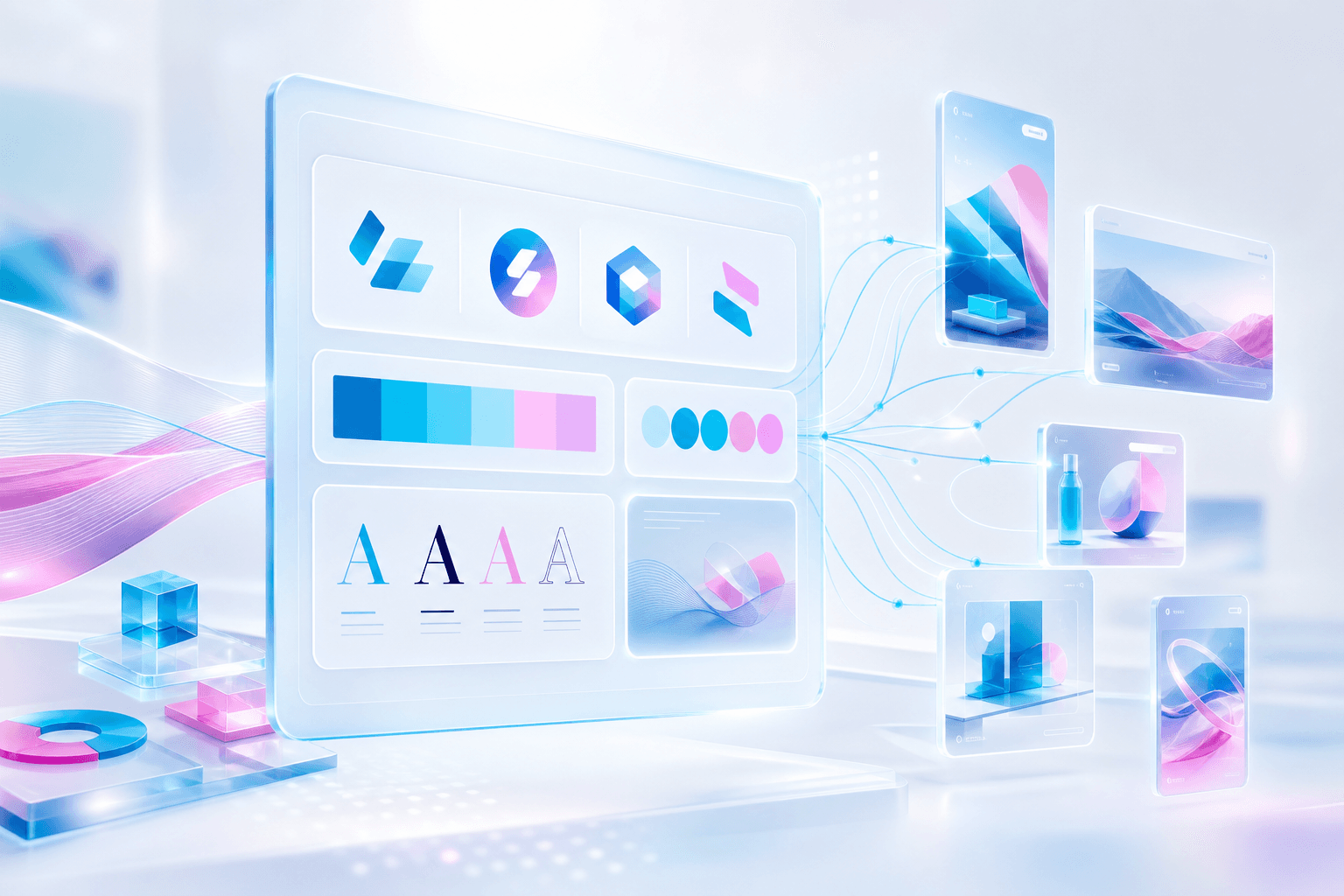
In practice, an AI brand kit is a structured library (logos, palette, typography, voice, photo style, do/don'ts) that your generative tools consume automatically on every creation. It turns a vague prompt like "summer sale banner" into a visual that hits your codes pixel-perfect. The same logic powers the AI-driven ROAS optimization on Google, where performance hinges as much on data as on creative consistency.
Anatomy of a high-performing AI brand kit
A traditional brand book is an 80-page PDF nobody reads. An AI brand kit is machine-readable: every rule is consumable by a model. Here are the essential building blocks to formalize in 2026.
- Atomic identity: SVG logo, monochrome variants, clear space, minimum sizes.
- Color system: primaries, secondaries, semantic colors, in HEX/RGB/CMYK with usage ratios.
- Type system: font families, size hierarchy, line heights, web fallbacks.
- Photo art direction: style (studio, lifestyle, editorial), lighting, framing, post-processing, mood references.
- Iconography: shape language, stroke weight, level of detail.
- Tone of voice: banned/preferred adjectives, register, headline length.
- LoRA templates or style references: training files feeding your generative models.

How to train AI to respect your visual identity
Three approaches coexist in 2026, and the right one depends on your creative volume and how distinctive your art direction is.
- 1Structured prompt engineering: inject your brand kit as a system prompt. Fast, cheap, perfect to start. Limit: models drift past a certain complexity.
- 2Style references and image-to-image: feed 3-8 reference visuals on every generation. Excellent mood fidelity, but won't lock fine details (exact logo shape, typography).
- 3Fine-tuning or dedicated LoRA: train a model on 50-200 brand visuals. The nuclear option: your brand becomes native to the model. Higher cost, unbeatable ROI past 500 monthly creations.
Mature teams stack all three: a LoRA as foundation, style references for campaign context, structured prompts for variants. This setup mirrors what we see in the comparison of AI creative tools for ads, where leading platforms now natively manage AI brand kits.
AI brand kit vs traditional brand guidelines: the showdown
A recurring question: should you ditch the PDF? No, but its role shifts. The PDF stays useful for humans (new hires, agencies, printers). The AI brand kit is the machine interface. Here's how they differ in practice.
| Criterion | PDF brand guidelines | AI brand kit |
|---|---|---|
| Format | Static 60-100 page PDF | JSON, tokens, LoRA, style refs |
| Reader | Human (designer, agency) | Generative models + humans |
| Updates | Yearly, heavy | Continuous, versioned |
| Production speed | 5-10 visuals/day | 100-500 visuals/day |
| Cross-team consistency | Variable, human-dependent | Constant by design |
| Marginal cost | High (designer per asset) | Near zero |
Rolling out an AI brand kit at scale: 5-step playbook
Here's the sequence we recommend for brands shipping 100+ creations per month, battle-tested across dozens of Meta Ads, Google Performance Max and TikTok Symphony accounts in 2026.
- 1Visual audit: pull 200-500 high-performing existing creatives, sort by channel, format and performance. That's your training base.
- 2Tokenization: convert every brand rule into a machine-readable token (HEX colors, modular prompts, negative constraints).
- 3Training and validation: train your LoRA or style profile, then generate 50 test visuals. Have your brand team blind-rate them.
- 4Industrialization: embed the brand kit into the generation platform used by your operators (social, performance, retail). Lock down critical parameters.
- 5Feedback loop: track creative performance, surface winning patterns, retrain the model every quarter.

Brands that operationalize this process turn creative production from a bottleneck into a competitive moat. It's also the key to fighting creative fatigue in advertising: a well-built AI brand kit doesn't crank out the same ad on loop, it spawns hundreds of testable variations on-brand. According to McKinsey, brands investing in personalization at scale generate up to 40% more revenue than peers.
Common pitfalls and guardrails to put in place
The costliest traps aren't technical, they're organizational.
- Brand kit built in a silo by marketing without art direction: gets rejected on delivery.
- Over-constraining the model: lock everything down and creativity dies, every variant looks the same.
- Under-constraining: leave the model loose and visual chaos returns.
- No versioning: impossible to know which kit produced which campaign.
- No quarterly review: the brand evolves, the kit must follow.
Set a consistency metric: a brand committee scoring 30 random visuals per month against a rubric (logo, palette, type, voice). Below 85% conformity, retrain. That discipline separates brands scaling cleanly from those producing visual noise. The same rigor applies to vertical formats: for scroll-stopping Instagram Stories and Reels, a tuned AI brand kit guarantees every variant stays recognizable in 1.5 seconds.
FAQ: your top AI brand kit questions
How long does it take to build an operational AI brand kit? +
Do I need an in-house designer to manage an AI brand kit? +
Is my AI brand kit portable across platforms? +
How do I measure AI brand kit performance? +
Conclusion: the AI brand kit, foundation of every creative strategy in 2026
The AI brand kit isn't a designer toy, it's the infrastructure that lets a brand scale creative production without diluting itself. Without it, generative AI is a brand risk. With it, it's a measurable performance lever powering dozens of campaigns at once across Meta, Google, TikTok and beyond. The brands pulling ahead in 2026 are the ones treating their AI brand kit as a strategic internal product, not a side deliverable.
Ready to industrialize your visual identity without losing your brand soul? Explore our AI generation platform: import your brand kit, generate at scale, keep control.
Écrit par
Équipe Market IA
L'équipe Market IA vous accompagne dans la création de publicités performantes grâce à l'intelligence artificielle.
Prêt à créer des publicités qui convertissent ?
Rejoignez +2000 e-commerçants qui utilisent Market IA pour créer leurs visuels publicitaires.