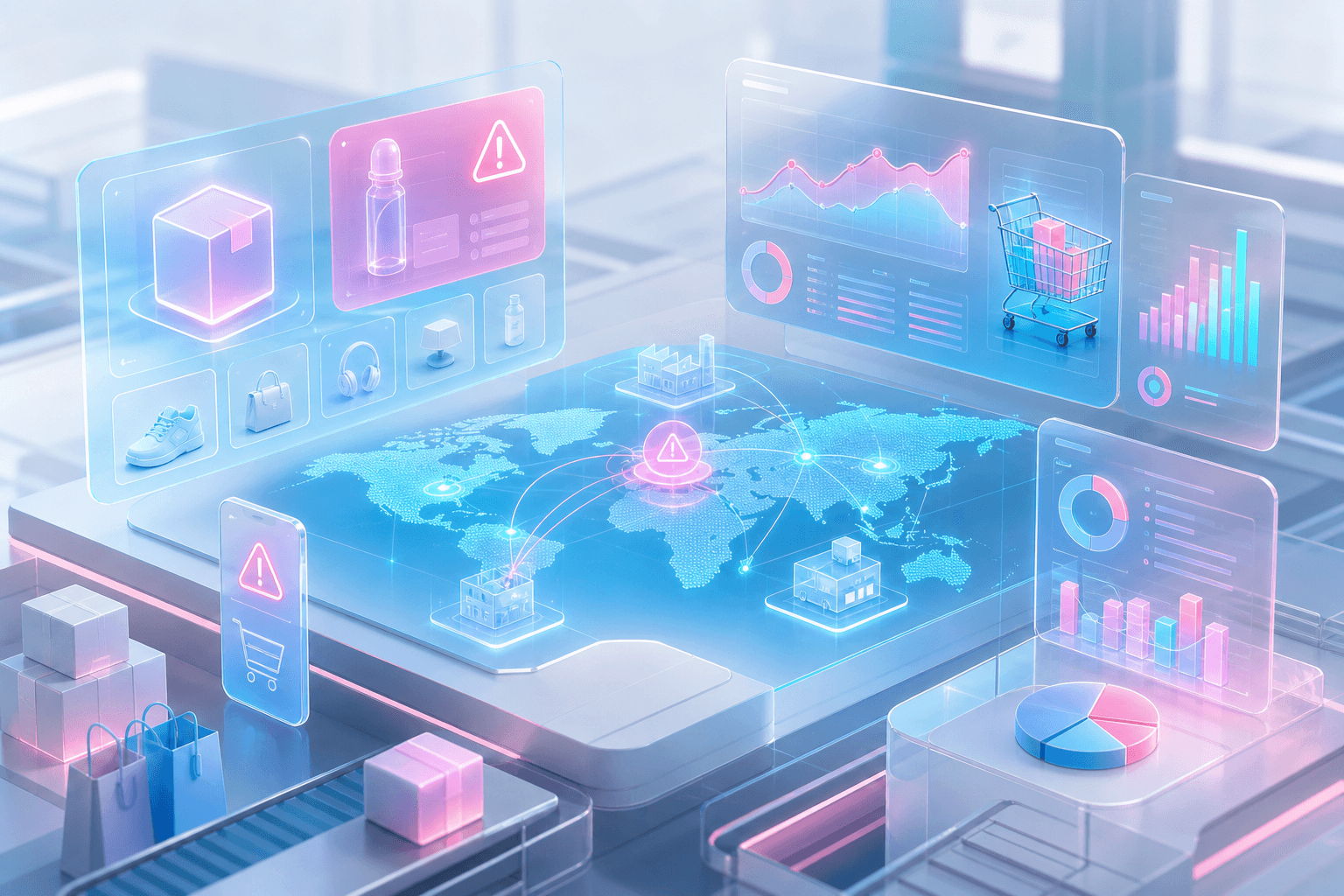
In 2026, a product recall is no longer a purely legal or logistical event — it's a marketing moment of truth. According to the latest European Commission figures, over 4,200 Safety Gate notifications were filed in 2025, up 18% in two years. How a brand orchestrates a product recall directly shapes trust, retention and the ROAS of every campaign for the following 12 months. This guide is built for DTC, retail, marketplace and FMCG marketers who want to turn a potential crisis into proof of reliability, with the right processes, tools and a healthy dose of generative AI.
What is a product recall in 2026?
A product recall is the structured withdrawal of a product already on the market because it poses a risk to consumer safety, health or compliance. Since the EU's GPSR took effect in late 2024 and was reinforced in 2026, any brand selling online — including via marketplaces — is responsible for traceability, alerting and compensation. The three main triggers are manufacturing defects, health risks (allergens, contamination) and documentation non-compliance (labeling, mandatory disclosures).
For marketers, the stakes go far beyond operations. A mishandled product recall poisons Google autocomplete for months, hurts Quality Scores on Search and inflates CPMs on cold Meta audiences. Conversely, a well-orchestrated recall becomes a trust asset that compounds over time.
The regulatory landscape every marketer must know
The GPSR mandates that brands notify authorities through the Safety Business Gateway within roughly 48 hours of detecting a risk. Data shared by Think with Google and the EU Safety Gate portal shows that the most affected 2025-2026 categories are toys, consumer electronics, cosmetics and fashion (restricted chemicals).
The concrete marketing obligations include:
- Publishing the recall notice on the homepage and in an indexable dedicated section
- Directly contacting every identified customer (email + SMS)
- Keeping the information live for at least 24 months
- Pausing any paid campaign featuring the product
- Updating product pages on marketplaces (Amazon, Zalando, Walmart, etc.)
EU data protection authorities explicitly allow the use of customer data for this purpose, even without marketing consent: a legal obligation overrides commercial opt-outs. That's a critical clarification for CRM teams who often hesitate to activate "unsubscribed" segments.

Anatomy of an effective product recall plan
A high-performing recall plan rests on five phases, documented BEFORE any crisis in a playbook signed off by leadership. The classic mistake is to improvise: brands without a playbook take an average of 5.4 days to publish their first official message, versus 19 hours for those who pre-scripted their scenarios.
- 1Detection and qualification: centralize weak signals (reviews, support tickets, IoT sensors, supplier alerts)
- 2Decision: small crisis committee (quality, legal, marketing, supply, leadership)
- 3Regulatory notification: Safety Business Gateway + sector-specific authorities
- 4Multichannel communication: email, SMS, push, social, PR, website, marketplaces
- 5Tracking and closure: return rate, refunds, post-mortem, playbook update
The most mature teams now add a sixth phase: win-back. Three to six months after closure, a reassurance campaign targets impacted customers using the same logic we cover in our piece on cutting customer acquisition cost with AI. The ROAS of these "comeback" campaigns often clears 6 in DTC because the audience is ultra-qualified and emotionally engaged.
| Criterion | Brand without playbook | Brand with playbook + AI |
|---|---|---|
| Time to first message | 5.4 days | 19 hours |
| Product return rate | 14% | 47% |
| Post-crisis NPS | -22 | +11 |
| Total crisis cost | $4.6M | $1.1M |
| Sales recovery (M+6) | -38% | +4% |
Crisis communication: marketing's strategic role
Marketing is often pulled in last, when it should be involved from detection. The reason is simple: marketing owns the behavioral data, routing tools (CDP, marketing automation) and the brand voice. Great recall communication respects four principles: speed, clarity, empathy and concrete action.
In practice, the message must answer in under 15 seconds: Which product? What risk? What should I do? How will I be compensated? Best practices in 2026 call for a dedicated, SEO-optimized landing page (product name + "recall" in the H1), a transactional email signed by the CEO, a short SMS with a secure link, and a 30-second vertical video distributed organically. For that last point, the short-form approach detailed in our TikTok playbook for marketers works exceptionally well for younger segments.

Generative AI and product recall: the game-changing use cases
Generative AI has reshaped product recall management between 2024 and 2026. Three use cases stand out. First, early detection: models like Gemini 2.5 Pro continuously parse Trustpilot, Amazon and Google reviews, support tickets and social chatter to surface weak signals 8 to 12 weeks before a defect becomes systemic. Research from McKinsey on data-driven growth and marketing shows this predictive detection cuts total crisis cost by 40%.
Second, content generation: GPT-5 and Claude 4.5 draft emails, FAQs, call-center scripts and press releases inside a pre-validated legal framework. Third, visual production: with a platform like Market IA, teams ship crisis comms visuals in minutes, localized by market, language and channel, without depending on a traditional studio cycle. That time saving is decisive when every hour matters.
A fourth use case is emerging: conversational AI agents handling tier-1 support during the crisis. Combined with the stack we cover in our deep dive on AI tools for enterprise in 2026, they absorb up to 70% of repetitive requests and free human teams for sensitive cases.
After the crisis: rebuilding trust and SEO
Once the crisis is closed, two workstreams matter. The first is reputation SEO: the recall notice page must remain live, dated, and clearly marked as "resolved". Brands that delete those pages see their authority drop because Google reads the deletion as a concealment signal. A transparent page, structured with schema.org/ProductRecall and linked to a final statement describing corrective actions, performs far better.
The second workstream is commercial win-back. According to recent analysis from Statista's digital advertising hub, 61% of consumers say they'd repurchase from a brand that handled a recall transparently, versus only 12% for those that minimized the incident. Practically, run a three-step CRM sequence: an apology and lessons-learned email at D+30, an exclusive offer at D+60 (free replacement, accessory, extended warranty), and progressive reintegration into acquisition campaigns from D+90.
FAQ: product recall in 2026
What's the difference between a product recall and a withdrawal? +
Should I pause all paid campaigns during a recall? +
How long should recall information stay online? +
Can AI really anticipate a product recall? +
Conclusion
A product recall in 2026 is no longer something brands suffer through — it's a process mature companies prepare, automate and turn into proof of integrity. With a battle-tested playbook, a cross-functional war room, transparent communication and generative AI to accelerate content and visual production, you can protect your brand and emerge stronger. Marketing has a central role to play, well beyond sending emails, in rebuilding consumer trust. Get ahead now: audit your processes and equip your teams with the creative tools they need.
Écrit par
Équipe Market IA
L'équipe Market IA vous accompagne dans la création de publicités performantes grâce à l'intelligence artificielle.
Prêt à créer des publicités qui convertissent ?
Rejoignez +2000 e-commerçants qui utilisent Market IA pour créer leurs visuels publicitaires.