

Google Marketing Live 2025 marked a historic pivot for online advertising. On the Mountain View stage, Google laid out a bold thesis: "Advertising has always evolved, and we're at the dawn of a new era. AI-powered advertising is no longer optional." For AI marketers, this edition isn't just another product keynote: it confirms that campaigns are going agentic, creatives are now generated in closed loops, and the advertiser's role is shifting from manual operator to strategic supervisor. This analysis of Google Marketing Live 2025 breaks down what really changes, and what you should do this week.
What Google Marketing Live 2025 actually announced
Beyond the polished stagecraft, three concrete shifts emerged for AI marketers. First: the general availability of AI Max for Search, blending semantic matching, dynamic creatives and automatic query expansion. Second: Asset Studio, the creative workshop now embedded in Google Ads that generates, edits and adapts visuals using Imagen and Veo. Third: Agentic Workflows inside Google Ads, where an AI agent owns full tasks (brief, targeting, creative, A/B test, optimization).
The official source, Google Marketing Live 2025 announcement, makes one point clear: these bricks aren't independent. They form a system where every signal feeds the next, from search to YouTube to Performance Max. The message is straightforward: Google no longer sells ad formats — it sells a full AI marketing infrastructure.
The agentic era: what Google Marketing Live 2025 changes for your campaigns
The single most important word in the keynote wasn't "AI" or "creative": it was "agent." Agentic Workflows turn Google Ads into an active copilot that takes initiative. In practice, an agent can analyze your site, propose a campaign structure, generate assets, launch variants and reallocate budget — without you touching tactical decisions.
For growth and e-commerce teams, this is a north star metric reset. The hours you spent tweaking bids or duplicating ad groups vanish. What gains value: the quality of your brief, the richness of your product feed, brand consistency and tracking rigor. Recent insights from McKinsey on AI-driven marketing show that companies industrializing these agentic workflows lift marketing productivity by 30–50% within 12 months.
That doesn't mean humans disappear. It means the role shifts: less execution, more strategic framing. It's the same pivot we covered in our breakdown of Meta's AI Drives Performance update, where the advertiser becomes a conductor rather than an operator.

Asset Studio and the end of creative scarcity
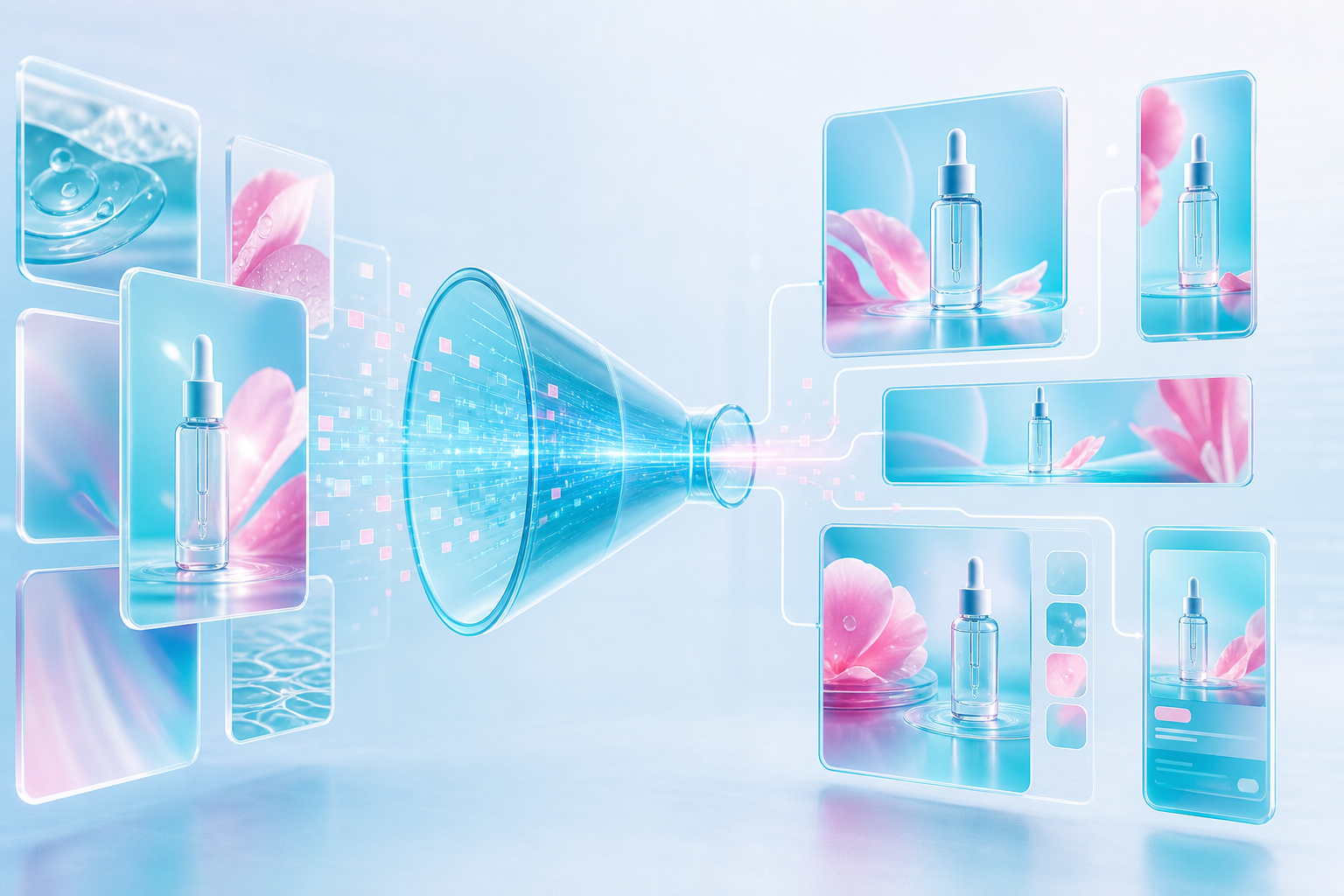
The second pillar of Google Marketing Live 2025, Asset Studio, deserves its own spotlight. The tool generates product images, background variants, format-specific compositions (1:1, 9:16, 16:9) and short videos via Veo 3. AI marketers finally have a native creative pipeline, with no need to juggle Photoshop, a generation tool and a resizing module.
The pitch echoes Meta's Advantage+ Creative. But Google pushes further on two fronts: direct integration with the product feed (so creative is anchored in commercial reality) and the ability to preserve brand consistency. For a deeper dive, our full Google Asset Studio breakdown walks through the recommended workflows.
None of this removes the need for strategic thinking. A solid brand kit is still essential, as we explain in our Brand Kit AI guide for scaled visual identity. Without that framework, Asset Studio simply produces more visual noise.
| Criterion | Google Ads 2024 | Google Ads post-GML 2025 |
|---|---|---|
| Creative production | External, manual | Native via Asset Studio (Imagen + Veo) |
| Search matching | Exact / Phrase / Broad | AI Max semantic with expansion |
| Campaign optimization | Smart Bidding + manual | Supervised autonomous AI agents |
| Attribution | Standard data-driven | Merlin AI cross-channel |
| Marketer's role | Tactical operator | Strategic conductor |
3 concrete implications of Google Marketing Live 2025 for marketers
From this keynote, I'd highlight three operational implications that every AI marketer should bake into their H2 2026 roadmap.
- 1Competitiveness now hinges on input quality. Product feed, first-party data, offline conversion signals: these fuel the agents. Companies that industrialize their data win mechanically over those who don't.
- 2Creative testing becomes a scientific discipline. With Asset Studio and continuous optimization, you can test 30, 50 or 100 variants per campaign at near-zero marginal cost. But that requires a rigorous test matrix — otherwise you'll drown in noise.
- 3Tracking and attribution become strategic again. Agents only optimize what they measure. Our Merlin AI attribution model guide walks through how to plumb your signals cleanly so the new capabilities deliver.
What Google Marketing Live 2025 means against Meta and TikTok
It would be naive to analyze this announcement in isolation. Meta has already shipped Advantage+ Creative and its video generation engine. TikTok is pushing Symphony with an auto-personalized creative library. What Google Marketing Live 2025 confirms is that the three giants are converging on the same model: the advertiser provides raw inputs (product, brand, goals), the platform orchestrates everything else.
For a marketer, that demands a coherent multi-platform strategy. Generated creatives have to live on YouTube, Reels and TikTok alike. Our guides on TikTok Ads AI creative best practices in 2026 and Google Ads: the 2026 complete guide can help you build that cross-channel layer.
Data published on Think with Google confirms a heavy trend: brands that adopt cross-channel AI workflows see an average ROAS lift of 18–25% versus single-platform setups. The question is no longer "should we go" but "how fast."
5-step action plan after Google Marketing Live 2025
Here's the roadmap I recommend to any AI marketer, e-commerce lead or growth manager walking out of this keynote:
- Audit your Merchant Center product feed: titles, descriptions, attributes, images. It's the agents' fuel.
- Activate AI Max for Search on a pilot campaign with a contained budget to measure real lift.
- Test Asset Studio on 3–5 priority SKUs while keeping human quality control.
- Build a creative test matrix (axes: hook, format, message, audience) to exploit variant scaling.
- Revisit your attribution and server-side tracking setup to feed the agents clean signals.
FAQ: Google Marketing Live 2025 and AI marketing
What exactly is AI Max for Search? +
Do Agentic Workflows replace agencies? +
Should we drop Performance Max for the new agents? +
When will these features be available worldwide? +
Conclusion: Google Marketing Live 2025 cements the agentic shift
Google Marketing Live 2025 isn't just another event. It's the moment agentic advertising stops being a promise and becomes operational reality. For AI marketers, the real risk is no longer mismanaging a campaign: it's failing to adapt your organization, data and creative supply chain fast enough to this new paradigm. Launch the pilots, industrialize your feeds, professionalize your testing — and lean on our AI generation platform to produce the creative volume these new engines demand. The competitive window is open today; it won't be in 12 months.
Écrit par
Équipe Market IA
L'équipe Market IA vous accompagne dans la création de publicités performantes grâce à l'intelligence artificielle.
Prêt à créer des publicités qui convertissent ?
Rejoignez +2000 e-commerçants qui utilisent Market IA pour créer leurs visuels publicitaires.