In 2026, building a high-converting landing page is no longer a multi-week agency project. With generative AI (Gemini 3 Pro, GPT-5, Claude 4.5), you can design, ship and optimize a landing page in hours, not weeks. According to recent figures from Statista – Digital Advertising, average customer acquisition costs are up 38% since 2023 across Meta and Google: your landing page is now the single biggest profitability lever you own. This guide breaks down the full method to leverage generative AI without ending up with a generic page that fails to convert.
What Is a Landing Page in 2026?
A landing page is a standalone web page built around a single conversion goal: capture an email, sell a product, trigger a free trial or book a demo. Unlike a homepage that opens many doors, a modern landing page focuses attention: one message, one promise, one CTA.
In 2026, the definition has expanded. A landing page now includes a conversational AI layer, dynamic personalization based on traffic source, and video hero modules generated through Sora 2 or Veo 3. The term covers B2B SaaS landing pages, e-commerce pre-order pages and lead-capture squeeze pages alike.
Generative AI has unlocked three historical bottlenecks: copywriting, visual design and video asset production. What stays human? Strategy, value proposition and deep audience understanding.
Why AI Is Reshaping Landing Page Design
Before 2024, building a best-in-class landing page required a copywriter, a UX designer, a front-end developer and a media buyer for testing. Today, one operator with the right stack ships in a day what teams used to ship in two weeks. The promise isn't just speed — it's testing 10 variants instead of one.
Generative AI shines on four fronts: rapid hero section variants, benefit-led bullet writing, brand-consistent visuals (see our comparison of the best AI creative tools), and predictive performance scoring before launch. Models trained on millions of converting pages can now spot winning patterns by industry.
The 7-Step Method for an AI-First Landing Page
- 1Lock in a single conversion goal (trial, demo, purchase, lead)
- 2Profile your audience with a structured persona injected into the AI
- 3Generate 5 different promise angles with GPT-5 or Claude 4.5
- 4Select and draft each block (hero, social proof, FAQ, CTA)
- 5Produce visuals with Nano Banana 2 or GPT-Image 2
- 6Assemble in a no-code builder (Framer AI, Webflow, Unbounce Smart Builder)
- 7Launch a multivariate A/B test on day one with the new Google Optimize successor
This playbook works equally well for a SaaS landing page or a physical product page. The key rule: never ship the AI's first draft. Iterate at least three times, challenging every block.
A Real Landing Page Example That Converts
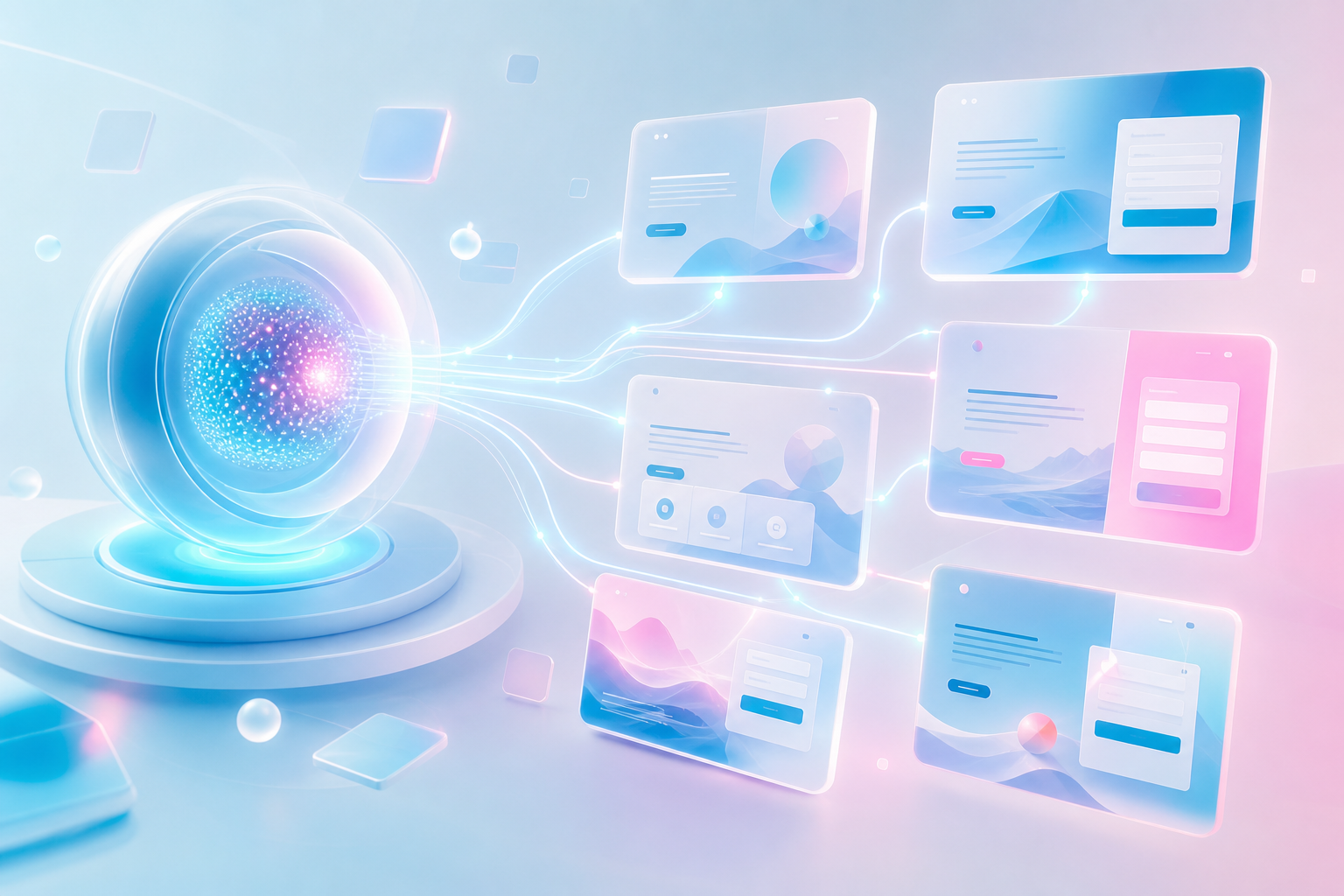
Here's a concrete landing page example: a B2B scale-up selling an analytics tool that rebuilt their page in March 2026. Pre-redesign conversion rate: 1.8%. After a copy rewrite driven by GPT-5 and an AI-templated design system, the page now hits 6.4%. The secret? Three structural shifts you'll find in most best-in-class 2026 landing pages.
| Block | Before (2023) | After (AI 2026) |
|---|---|---|
| Headline | Generic feature-led | Outcome-led, quantified, UTM-personalized |
| Hero visual | Stock photo | 8s generative video + animated UI |
| Social proof | 3 client logos | Video testimonials + live G2 scores |
| CTA | "Learn more" | Contextual CTA + pre-demo AI chatbot |
| FAQ | 5 fixed questions | FAQ generated from detected objections |
| Mobile | Standard responsive | Thumb-first redesigned layout |
Most high-performing landing page examples share one trait: they actively avoid creative fatigue. We dive deeper into this dynamic in our creative fatigue playbook, and the principles apply equally to landing pages and ad creative.
The 6 Must-Have AI Tools in 2026
The stack has shifted dramatically this year. Legacy editors (Webflow, Framer, Unbounce) all shipped native AI layers, while new full-AI players have emerged. Here's the shortlist we recommend to growth teams, validated across 200+ client projects.
- Framer AI 3.0: full-page generation from a prompt + Figma sync
- Webflow AI Designer: automated redesigns that respect your design system
- GPT-5 + Claude 4.5: strategic copy and A/B variants
- Nano Banana 2 / GPT-Image 2: hero visuals and section illustrations
- Veo 3 / Sora 2: 5-10s hero videos
- Mutiny / Intellimize Next: post-launch dynamic personalization
For the ad creative driving traffic to your page, brand consistency matters: that's exactly where our AI generation platform earns its keep, syncing visual identity from ad to landing page.
Optimizing Conversion: KPIs and AI-Driven A/B Testing
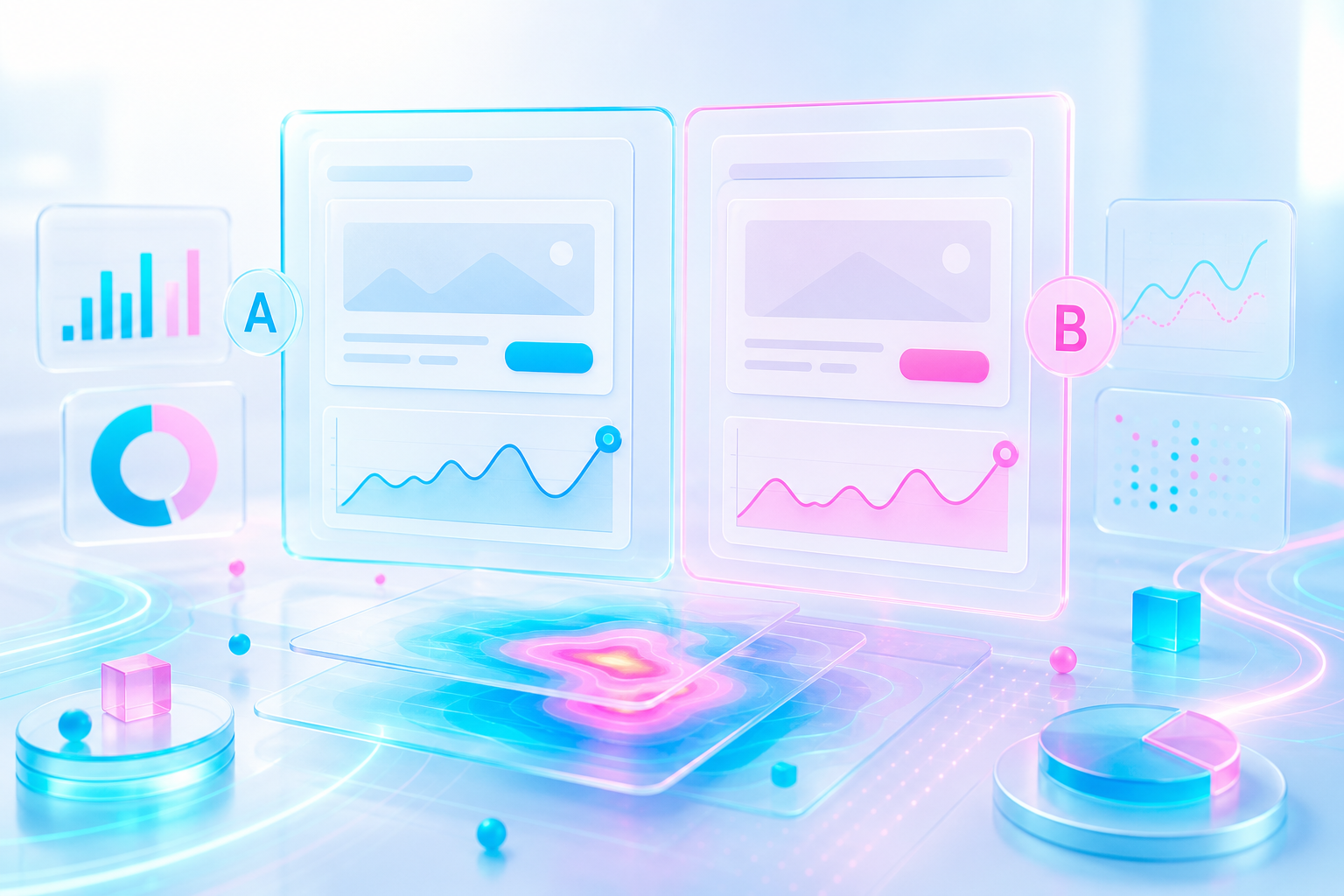
A high-conversion landing page isn't measured by conversion rate alone. In 2026, top-performing teams track four north stars: conversion rate, time-to-first-action, weighted scroll depth, and AI-scored lead quality. A recent study published on Think with Google shows that pages tested continuously through Bayesian models lift ROAS by 34% on average over 90 days.
New-generation attribution tools, as covered in our complete Merlin AI attribution guide, now connect each landing page conversion to its true source channel — and adjust content dynamically per source.
Critical Mistakes to Avoid With AI-Generated Pages
AI can generate a beautiful page that doesn't convert. Three mistakes show up consistently with teams new to generative AI.
First, vague prompts: asking "build me a SaaS landing page" returns interchangeable content. Always inject ICP, differentiators and 2-3 best landing page references as inspiration.
Second, no human validation on the promise. AI can fabricate benefits your product doesn't deliver. Every claim must be verified.
Third, over-polished visuals at the cost of readability. A slick design is useless if the information hierarchy is broken. To dig deeper into downstream ad performance optimization, see our piece on optimizing Google ROAS with AI.
Finally, beware of overused templates. Studies on Moz Blog confirm that visual differentiation remains a major driver of memorability and trust, especially in saturated markets.
What exactly is a landing page? +
What's a great example of a high-converting landing page? +
How long does it take to build a landing page with AI? +
What conversion rate should a SaaS landing page target? +
Conclusion: Your Next Landing Page Starts Today
The landing page is now the most profitable growth lever in your marketing stack. With generative AI, there's no excuse left for shipping a mediocre page: the technical barrier is gone, only the quality of your strategy and prompts now sets you apart. Whether you're launching a SaaS landing page, an e-commerce product page or a lead-capture squeeze page, the method holds: brief sharply, generate broadly, select rigorously, test relentlessly.
Ready to turn your next landing page into a conversion engine? Discover Market IA and generate visuals that stay perfectly aligned with your destination page in minutes.
Écrit par
Équipe Market IA
L'équipe Market IA vous accompagne dans la création de publicités performantes grâce à l'intelligence artificielle.
Prêt à créer des publicités qui convertissent ?
Rejoignez +2000 e-commerçants qui utilisent Market IA pour créer leurs visuels publicitaires.