

In 2026, producing Meta Ads visuals without generative AI is like running a marathon in flip-flops. Advertisers who industrialize creative production with models like Gemini 3 Pro, GPT-5 Vision, or Midjourney v7 are shipping 4x faster and seeing CTR lifts of 30 to 70%. Yet many marketers still hesitate: which tools to choose, how to keep brand consistency, how to stay GDPR-compliant? This practical guide walks you step by step through creating high-performing Meta Ads visuals with AI, leveraging the latest Advantage+ Creative features and avoiding the pitfalls that wreck ad accounts.
Why AI is now mission-critical for Meta Ads campaigns
Since Advantage+ Creative Studio launched in summer 2025, Meta's entire ad ecosystem has been built on layers of generative AI. Algorithms automatically remix your visuals, test variants, and adapt aspect ratios to each placement (Feed, Reels, Stories, Marketplace). According to data from Meta Ads Business, accounts fully leveraging Advantage+ AI tools see an average 22% ROAS lift compared to non-automated accounts.
The reason is simple: creative fatigue now hits cold audiences within 5 to 7 days. Without an AI-assisted production pipeline, it's impossible to keep up. To dive deeper into this exact challenge, check out our dedicated piece on beating creative fatigue with AI.
In practice, three use cases dominate 2026:
- Static visual generation (carousels, single image, collections) from text prompts or product briefs
- Short-form video variant creation (6-15 seconds) for Reels and Stories via Sora 2, Veo 3, or Runway Gen-4
- Automated multi-format adaptation through AI agents inside Meta Ads Manager
The best AI tools to create Meta Ads visuals in 2026
The market has matured into three clear tool families. Native Meta generators (Advantage+ Creative, Meta AI Studio) are perfect for quick edits: background swaps, image extension, copy variants. They remain limited on fine creative control.
Specialized ad platforms — including our AI creative platform — let you produce Meta-native visuals with guaranteed brand consistency via a brand kit. This approach is detailed in our guide on building an AI brand kit at scale.
Finally, general-purpose models (Midjourney v7, DALL·E 4, Stable Diffusion 4, Gemini 3 Pro Image) offer maximum creative control but require more post-production work.
| Criteria | Native Advantage+ | AI Ad Platform | Generic Tool |
|---|---|---|---|
| Brand consistency | Medium | Excellent | Variable |
| Production speed | Very fast | Fast | Medium |
| Creative control | Low | High | Maximum |
| Ad-native optimization | Excellent | Excellent | None |
| Monthly cost | Included | $30-200 | $10-60 |
A concrete workflow: from prompt to live Meta Ads creative
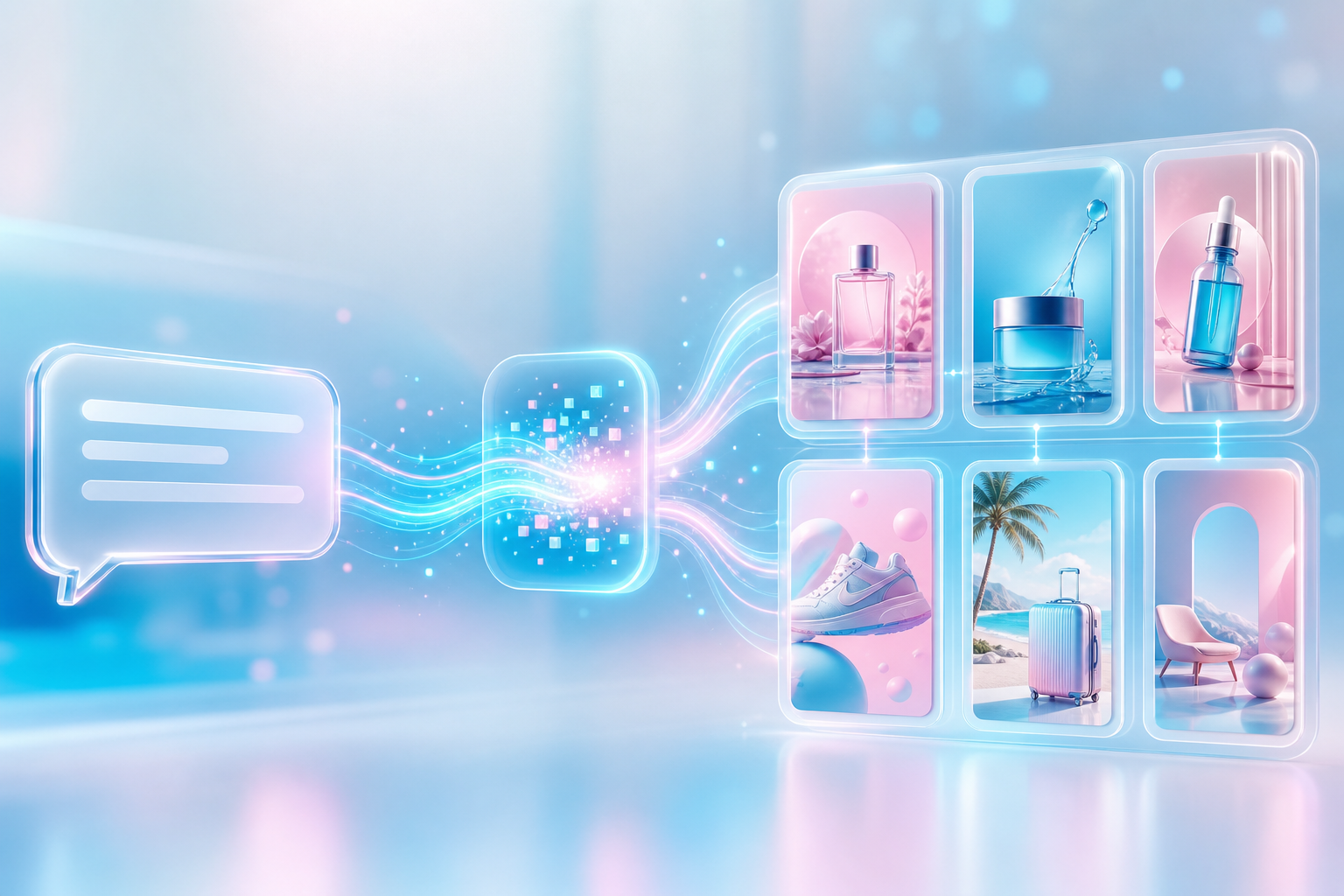
An effective AI workflow for Meta Ads follows five steps. Step one, competitive analysis: before generating anything, dive into the Meta Ads Library to identify the visual codes winning in your niche. Pull 20 to 40 active ads, sort them by angle (problem, solution, social proof, urgency).
Step two, structured creative brief. A great AI prompt in 2026 always contains four layers: main subject (product + scene), visual style (photoreal, 3D illustration, flat design), brand elements (palette, typography, logo), and technical specs (1:1 ratio for Feed, 9:16 for Reels and Stories).
Step three, generation with variants. Always produce 6 to 12 visuals per angle to enable statistically meaningful tests. Step four, multi-format adaptation through native tools or specialized platforms. Step five, upload into Meta Ads Manager with Advantage+ Creative enabled to multiply combinations.
How to write prompts that actually convert
The quality of a Meta Ads visual is 80% prompt-driven. In 2026, multimodal models like Gemini 3 Pro and GPT-5 accept hybrid text + reference image prompts. Adopt the SCAB framework: Scene, Camera, Ambiance, Brand.
Applied example for a clean-beauty brand: "Macro photograph of an amber serum bottle on white marble stone, water droplets, soft side-morning natural lighting, sharp product focus, shallow depth of field, beige and sage green palette, premium editorial style, 1:1 ratio, ultra-realistic, 8K."
Common mistakes to avoid: prompts that are too short (under 30 words), missing usage context, forgotten aspect ratio, conflicting adjectives. For social ads in video format like TikTok creative best practices, always add the target duration and pacing (fast cuts, one-shot, time-lapse).
Meta, personal data, and AI: the 2026 compliance playbook
The topic of personal data and AI under Meta has become central since the full EU AI Act enforcement in February 2026. You can no longer use AI-generated visuals reproducing a real identifiable face without explicit consent. Meta has also tightened policies: AI-generated visuals featuring people must be labeled via the "AI-generated content" toggle in Meta Ads Manager.
According to research by McKinsey on growth marketing and sales, 41% of European brands have already implemented a legal validation workflow for AI creatives. It's now a standard, not an option.
Best practices to implement immediately:
- 1Use only models trained on licensed datasets (avoid undocumented community checkpoints)
- 2Store prompts and metadata for each generated asset (traceability)
- 3Always activate the AI flag in Meta Ads Manager for relevant visuals
- 4For faces, prefer 100% generated stylized characters over photoreal humans
- 5Partner with a Facebook ads agency or consultant who masters these constraints
Test, measure, iterate: the AI performance loop
The real value of AI isn't just speed — it's learning velocity. Set up a 3-axis test matrix: angle (3 to 5 hook angles), format (single image, carousel, short-form video), and visual style (photoreal, illustration, simulated UGC).
With just $50 per variant over 3 days, you typically get a usable statistical signal on CTR and CPM. Winning variants are then scaled through Advantage+ Shopping or Sales campaigns. According to benchmarks published by Statista on digital advertising, advertisers testing at least 15 creatives per month report a ROAS 1.8x higher than the market average.
Log winning patterns in a centralized "creative database": dominant color, hook type, product placement, presence of a face. These learnings then feed your next AI prompts in a virtuous loop. This is exactly the logic we explore in our piece on AI tools for enterprise marketers.
Meta, personal data and AI: what are the 2026 rules? +
How many AI creatives should you ship monthly for Meta Ads? +
How to leverage the Meta Ads Library with AI? +
Do you still need a Facebook ads agency in 2026? +
Conclusion: AI is the new baseline for Meta Ads creatives
In 2026, creating Meta Ads visuals with AI is no longer a competitive edge — it's table stakes. Advertisers who combine a structured workflow, precise prompts, AI Act compliance, and a rigorous test-and-learn loop are crushing competitors on ROAS. Whether you run campaigns in-house or via a Facebook ads agency, the challenge is the same: industrialize a performant, compliant creative production. With Market IA, you have a platform built for exactly that — turning briefs into Meta-ready visuals in minutes, ready to ship inside Meta Ads Manager.
Écrit par
Équipe Market IA
L'équipe Market IA vous accompagne dans la création de publicités performantes grâce à l'intelligence artificielle.
Prêt à créer des publicités qui convertissent ?
Rejoignez +2000 e-commerçants qui utilisent Market IA pour créer leurs visuels publicitaires.