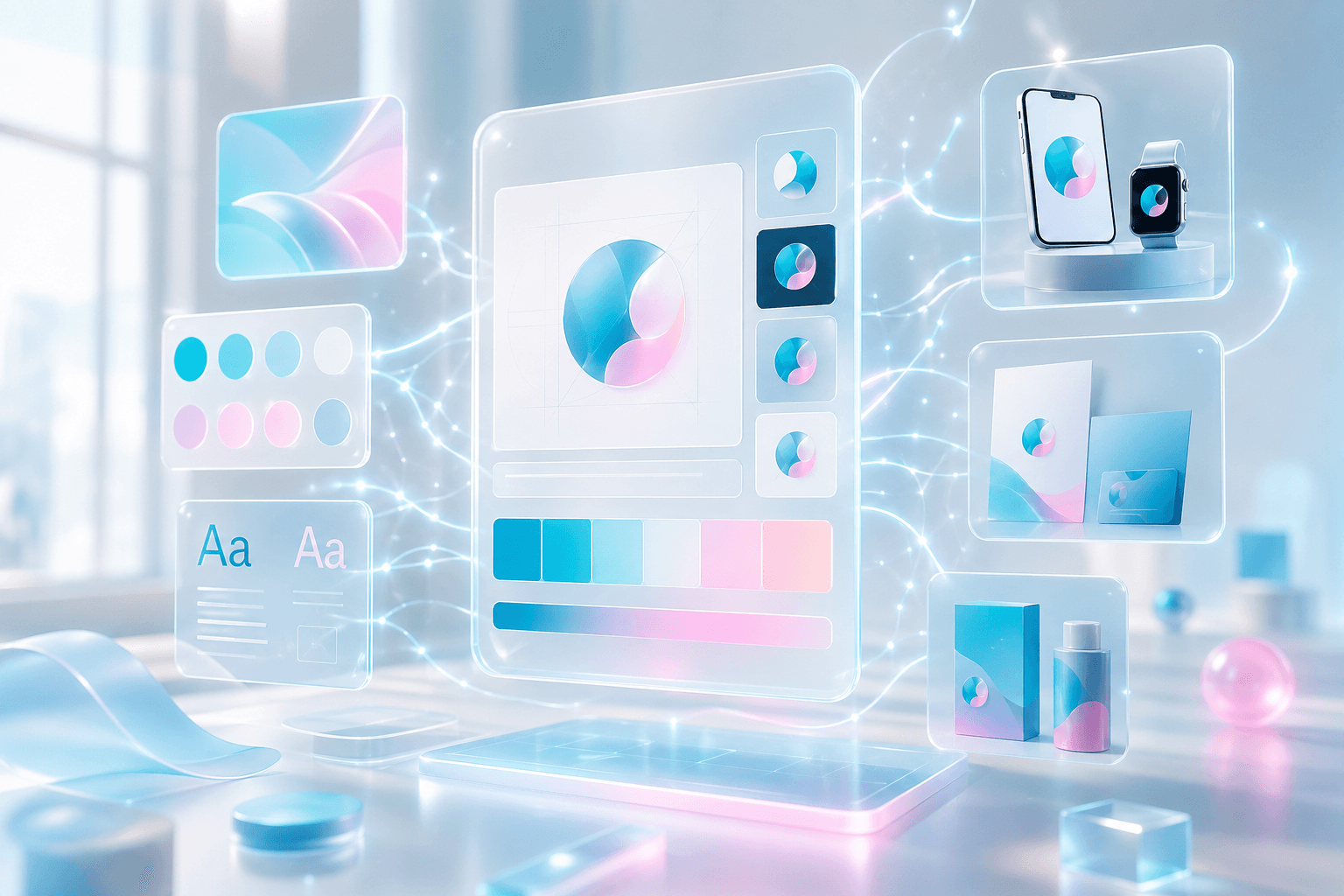
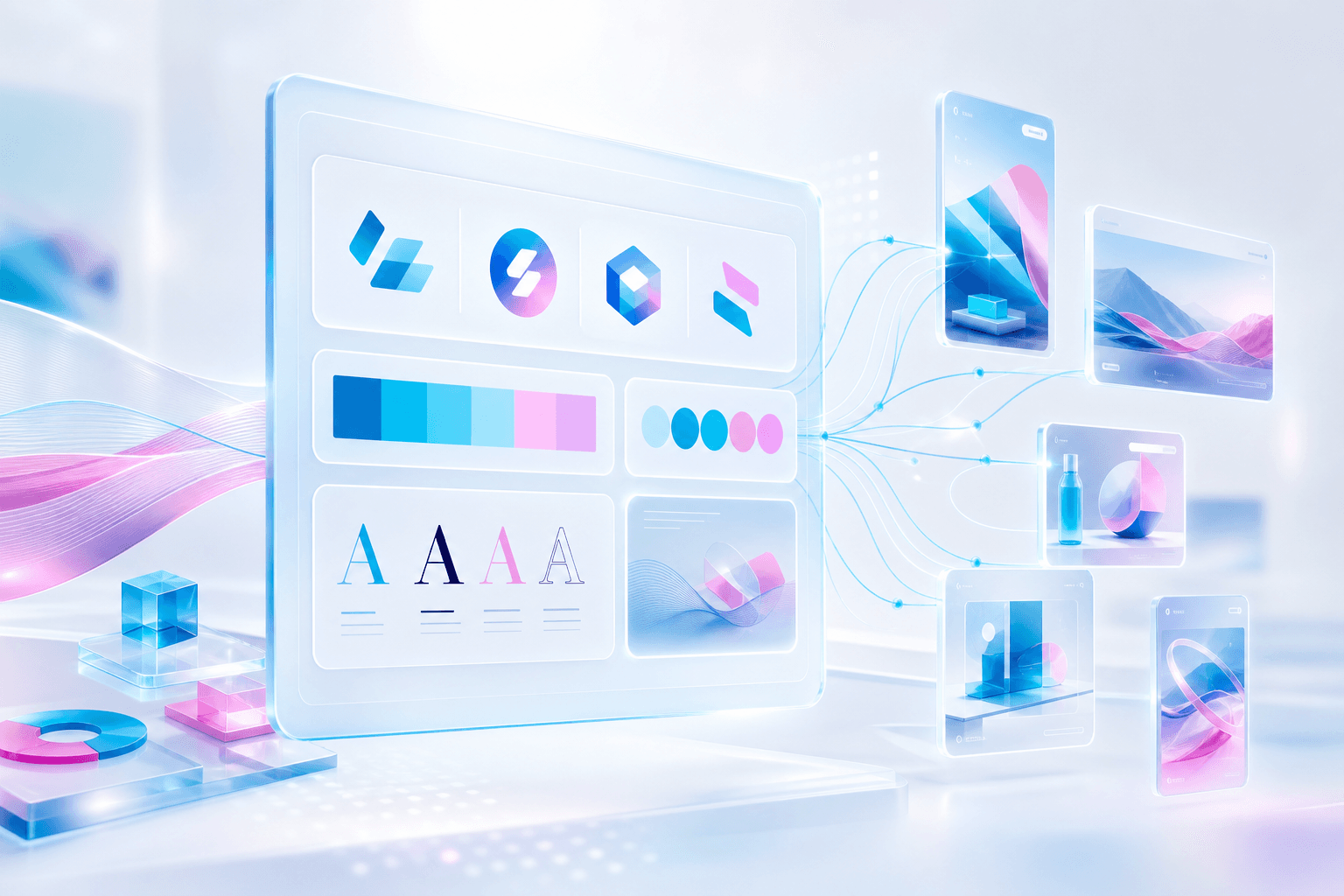
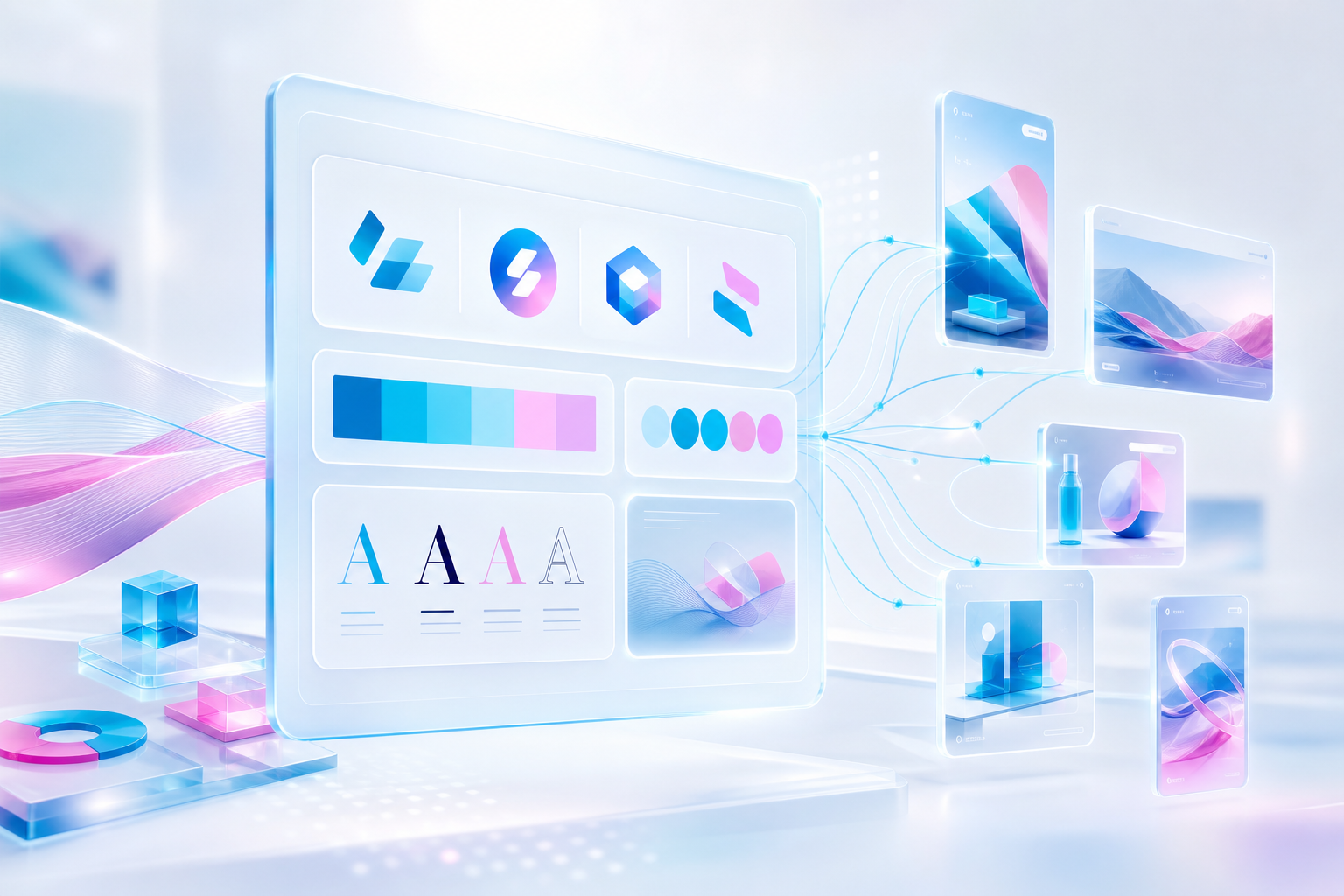
In 2026, a high-performing consumer brand ships an average of 1,200 ad creatives per month across Meta, Google, TikTok, LinkedIn and its website. Without a structured AI brand kit, that creative volume turns into a nightmare: stretched logos, fuzzy palettes, random typography, off-tone copy. The AI brand kit solves exactly that: it encodes a brand's visual DNA into a machine-readable format and injects it automatically into every piece of generated content. Result: 95% brand consistency across thousands of assets, where teams used to struggle to keep 60% alignment on just a few dozen pieces.
This guide unpacks what an AI brand kit looks like in 2026, why it matters, how to build and roll it out at scale, and which tools dominate the market.
What is an AI Brand Kit in 2026?
The AI brand kit is the natural evolution of the traditional brand guidelines deck. Where a 60-page brand book PDF used to serve as a human reference, the AI brand kit is a structured repository, readable by generative models (Gemini 3 Pro, GPT-5, Claude 4.5, Nano Banana 2, Midjourney V8), that automatically drives the creation of visuals, videos and copy.
In practice, an AI brand kit encapsulates:
- Visual assets: vector logos with all variations (monochrome, white, dark background), primary and secondary color palettes (HEX, RGB, CMYK, Pantone), primary and secondary typography with approved weights.
- Usage rules: logo clear space, minimum sizes, forbidden combinations, type hierarchy.
- Narrative elements: tone of voice, preferred vocabulary, banned words, brand persona, legal claims.
- Visual references: photography style, illustration type, recurring patterns, approved moods.
What AI changes in 2026 is that these rules are no longer just consulted — they are injected live into prompts, automatically verified by vision models, and corrected before publication. To go deeper into the broader stack, our overview of enterprise AI tools in 2026 covers the technical building blocks.
Why Visual Consistency Has Become Mission-Critical
Channel fragmentation has exploded: the same marketing message now needs to live in 9:16 for Reels and TikTok, 1:1 for the feed, 16:9 for YouTube, 4:5 for Pinterest, plus display banners, email and newsletters. According to research surfaced on Think with Google in 2025, brands maintaining a stable visual identity across all touchpoints generate on average 23% more revenue than peers whose identity drifts.
Second pressure: the creative volume mandated by the algorithms. Meta Advantage+ and Google Performance Max now recommend 30 to 100 variants per campaign to fully exploit their AI agents. Without an AI brand kit driving automation, that volume is unreachable without diluting the brand.
The Essential Components of a High-Performing AI Brand Kit
An operational AI brand kit in 2026 goes beyond a static asset bundle. It's structured around five interdependent layers:
- 1Identity layer (logos, colors, type, shapes).
- 2Style layer (visual references, image embeddings, in-house LoRAs).
- 3Narrative layer (system prompts, tone of voice, lexicon).
- 4Context layer (channel-specific variations, formats, audiences, funnel stages).
- 5Governance layer (approval workflows, usage rights, versioning).

The style layer is arguably the most differentiating. Generative image models (Nano Banana 2, Midjourney V8, Ideogram 3) now accept multiple visual references as conditioning. By feeding 15 to 30 representative in-house images, you produce outputs with an instantly recognizable signature. Combined with a fine-tuned LoRA, this approach exceeds 90% style consistency, according to recent benchmarks shared on the Google AI Blog.
AI Brand Kit vs Traditional Brand Guidelines
| Criterion | Traditional guidelines | AI brand kit |
|---|---|---|
| Format | Static 40-80 page PDF | JSON/API + vector assets + embeddings |
| Updates | Annual, agency-driven | Continuous, Git-versioned |
| QA | Manual, spot-checks | Automated via vision AI |
| Volume | ~50 assets/month | 1,000 to 10,000 assets/month |
| Marginal cost | High (designer per asset) | Near-zero after setup |
| Time-to-market | 2 to 5 days | 2 to 15 minutes |
How to Roll Out an AI Brand Kit at Scale
A successful AI brand kit deployment follows a four-phase playbook. Phase one is formalizing what already exists: consolidating logos, palettes, type and best-in-class examples into a single source of truth. Use a structured format (JSON, YAML) alongside the binary files (SVG, fonts, reference images).
Phase two covers training and embedding. You can either fine-tune a light image model on your corpus or generate style embeddings that you inject at every call. For brands with a highly distinctive style, a LoRA remains the best option (quality beats generalization).
Phase three, orchestration, is the most overlooked. It means wiring the AI brand kit into downstream production tools: ad creative generators, landing page builders, video script generators. Our guide on building Meta Ads creatives with AI in 2026 covers this integration for Meta, while high-converting landing pages with generative AI addresses the web side.
Phase four is automated QA. A vision model (GPT-5 Vision, Gemini 3 Pro) compares each output against the brand kit and assigns a compliance score. Below a threshold (typically 85%), the asset is rejected or regenerated.

The AI Brand Kit Tools Leading in 2026
The ecosystem has settled around three tool families. Native platforms integrated with ad networks come first: Meta Advantage+ Brand Center, Google Ads via Asset Studio, and TikTok Symphony Brand Suite all ship their own brand kit logic, optimized for their ecosystem. Our breakdown of Google Asset Studio details how this layer plugs into Performance Max.
Independent specialized tools form the second family: Brandwise, Frontify AI, Canva Brand Kit Pro, Adobe Express Brand, and of course Market IA, which combine asset management, multi-format generation and quality control. Finally, custom AI agents built on Claude 4.5 or Gemini 3 Pro with internal vector databases appeal to large brands looking for full control.
Measuring Consistency and Business Impact
An AI brand kit without KPIs is an opaque investment. Mature brands track four north star metrics.
- Brand consistency score: percentage of assets auto-approved as compliant (target > 90%).
- Time-to-creative: average duration between brief and delivered asset (target < 30 minutes).
- Creative output volume: number of variants produced per campaign (target 10x vs human baseline).
- Incremental brand lift: measured via brand lift studies on Meta and Google, comparing AI brand kit campaigns to a control group.
According to a McKinsey study published in late 2025, advertisers running a mature AI brand kit report a 19% lift in average ROAS on paid social campaigns, explained primarily by better recall and delayed creative fatigue. To close that measurement loop, the approach in AI Drives Performance 2026 remains a solid compass.
FAQ: AI Brand Kit in Practice
How long does it take to build an operational AI brand kit? +
Does an AI brand kit replace an art director? +
How do you prevent AI from drifting off-brand? +
Does an AI brand kit work for video too? +
Conclusion: Industrialize Without Diluting Your Brand
The AI brand kit is no longer optional in 2026 — it's the prerequisite for shipping the creative volume that ad algorithms now demand without diluting brand perception. Advertisers structuring their AI brand kit today secure a strategic lead that's hard to close: they iterate faster, test wider and learn deeper than their competitors.
The core promise is simple: 10x your creative output while gaining consistency. That equation, unthinkable two years ago, is now within reach for any marketing team willing to invest in the infrastructure and the method.
Ready to make the move? Discover how our AI generation platform plugs your AI brand kit directly into ad production workflows, for on-brand, high-performing creatives shipped at scale.
Écrit par
Équipe Market IA
L'équipe Market IA vous accompagne dans la création de publicités performantes grâce à l'intelligence artificielle.
Prêt à créer des publicités qui convertissent ?
Rejoignez +2000 e-commerçants qui utilisent Market IA pour créer leurs visuels publicitaires.